
crooked timelines
on the veil between worlds, time zones, & the desire to just eat soup and sleep

Dear Beloved,
On Hallow’s eve, when the veil between worlds was thinnest, it felt like passing through one timeline to another. A curtain dropped.
Or maybe it’s just daylight’s savings times. The sudden darkness at 5 PM always startles me.
Or maybe it’s the passing of election night, one year since 2024’s grim presidential election. Grief has completed a rotation around the sun, and the anniversary collided with a victory on Tuesday. I’m still stumbling in the dissonance.
Time is not as linear as some would have us think. These times - unprecedented, uncertain, challenging, of monsters - are crooked. We stand in a vestibule of the present, pressed between those who wish to return to a past of their own imagination, a mutation of cruel realities and crueler myths, and a future of our own humane creation.
In Time and the Colonial State, French-Tunisian working-class activist Meryem-Bahia Arfaoui wrote, “Colonization imposes definitions of time across space — or the domination of time through the appropriation of space. The imposition of the capitalist-State as the ultimate form of social organization creates a standard temporal referential (modernity) whose main functions are to normalize the negation of any other social temporality and to establish State dominion over any other social structure. On the world map, we can observe how time zones require all of humanity to live at the same rhythm of ‘progress.’ These lines are also borders.”
Colonization also tricks us into thinking there’s not enough time, there’s not enough money, there’s not enough of anything except for everything that’s already there, but I think that’s a mythology.
- X’unei Lance Twitchell
It’s within these borders that we come to a pervading symptom of white supremacy culture: urgency.
Urgency is the engine. It drives us to hustle, capitalize, optimize, destroy, innovate, produce, monopolize. It demands our time, our energy, our resources, our bodies, our thoughts, our attention. Everything.
This colonized society coerces us to move at the speed of urgency rather than the speed of trust. It steals from us. It tells us there is no time to rest, to be in community.
I feel the turn of the season in my bones. Each heavy day, the light fades into autumn. The urge to nest in some sweaters and crochet blankets grows. I’ve picked up knitting again. I’m eating more, nourishing my body with lentil soups and curries. The crock pot is out. By 4 PM, I’m ready for bed.
Yet phone notifications keep ringing, people keep are hustling, industrial wheels keep turning.
Further Reading
In Why changing the clocks for daylight saving time runs counter to human nature, Rachelle Wilson Tollemar (Cherokee) wrote, “In this Indigenous context, daylight saving time is nonsensical, if not outright comical. Time can’t be changed any more than a clock’s hands can grab the sun and shift its position in the sky. The sun will continue to cycle at its gravitational will for generations — and economic systems — to come.”
Rasheedah Phillips, author of Dismantling the Master’s Clock, shared in The Funambulist, “Clocks are themselves maps, offering another way of spacing time and timing space. Like maps, clocks are objects that embody certain ideas, politics, notions of time, and boundaries. For example, we find that clocks, time, and slavery are also intimately bound. […] …the inscription of linear space-time can be discerned in slave ownership in the American South. 36°30’ North is the parallel of latitude that divided the United States between where slavery was allowed (U.S.) and prohibited (Confederate States) under the Missouri Compromise. The idea of slave and master even extended into the development of mechanical clock time technology as clock makers in the early 19th century created systems of synchronization, with the concept of ‘master’ clocks to ‘slave clocks.’”
Meanwhile, in Hawai’i', the term “island time” echoes similar concepts of “Indian time” in reservations or “Latino time” - each a comparatively relaxed, less rigid form of time. In “What It Really Means to Be on Island Time,” this divergence between island time and mainlander time is attributed to sugar plantations. Professor Davianna Pōmaika‘i McGregor, a founding member of the ethnic studies department at the University of Hawaiʻi at Mānoa, breaks it down:
Plantation owners, who were mostly descendants of missionaries, enforced stringent 10-hour work days that defied the Native Hawaiian approach to planting, which centered around the cycles of the sun and moon and the two seasons, kauwela (the hot season from May to October), and ho‘oilo (the wet season from November to April).
James Viernes, a Chamorro scholar from Guam, describes islander time as a form of everyday peasant resistance. “I think the reason we take so much pride in this ‘island time’ is that yeah, it’s funny, but if you really look at it, there is a level of resistance in that term—in saying that, despite all this history of outside influence coming in and dominating us, we’re still insisting on our Hawaiian time, our Chamorro time, our Fijian time. An insistence on island time is a way of maintaining island identity.”
In short, it’s a claim to sovereignty.
What does your culture, alive today or buried deep in ancestral memory, say about time? How are you reclaiming sovereignty, autonomy, and time? What are your everyday exercises in peasant resistance?
Seeds for Change
Radical Mental Health First Aide - Nov. 19 | 9 AM PST (sliding scale)
Co-facilitated by Khumo Masege and Laila Makled, this workshop offers de-escalation strategies; practices for care during holiday-relate triggers and crises; and non-carceral resources, tips, and tools.De-Google Your Digital Life: Reclaiming Agency & Building Sustainable Digital Habits - Nov. 21 | 11 AM PST
Sick of giving your data away to evil corporate overlords? Want to pull away from genocide profiteer Google? Want to protect yourself? Join this upcoming training by the trans futurist collective.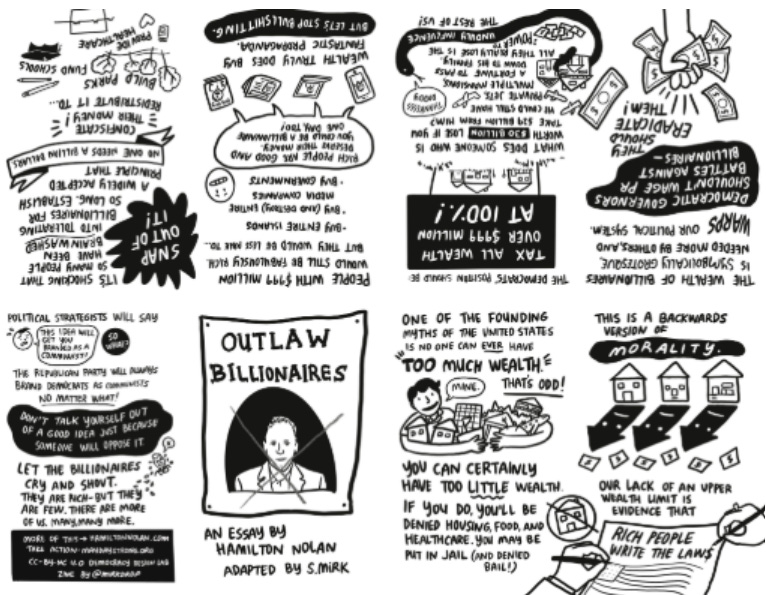
Print & distribute Outlaw Billionaires - a zine written by Hamilton Nolan and illustrated by S. Mirk.
